
Introduction to Databricks: Understanding Data Engineering, Analytics and AI

Introduction
Every modern organization generates data through business applications, websites, mobile applications, customer transactions, databases, and enterprise systems.
However, collecting data is only the beginning. Businesses need to process, organize, analyze, and transform that information into meaningful insights before they can use it for decision-making.
This is where Databricks becomes important.
Databricks is a unified data and AI platform that supports data engineering, large-scale data processing, analytics, machine learning, and artificial intelligence.
At RUSA Analytics, we explore modern data technologies and explain how platforms such as SAP, Databricks, and Power BI work together in enterprise data environments.
In this second article of our SAP and Databricks Learning Series, we will understand what Databricks is, how its Lakehouse architecture works, the role of Apache Spark and Delta Lake, and how organizations use Databricks for analytics and AI.

1. What Is Databricks?
Databricks is a unified platform designed to help organizations work with data and AI at scale.
It brings together several important capabilities, including:
Data engineering and data processing.
Data integration and transformation.
Data analytics and SQL.
Machine learning and artificial intelligence.
Data governance and secure data sharing.
Business intelligence and reporting workflows.
Instead of treating data engineering, analytics, and machine learning as completely separate activities, Databricks provides an environment where these workloads can work together.
For example, imagine an e-commerce company.
It collects information from online orders, customer accounts, website activity, payment systems, and product databases.
Databricks can help the organization process and combine relevant information, prepare analytical datasets, and support machine learning models that predict future customer demand.
To understand the official platform capabilities, explore the Databricks Documentation.
2. What Is a Data Lakehouse?
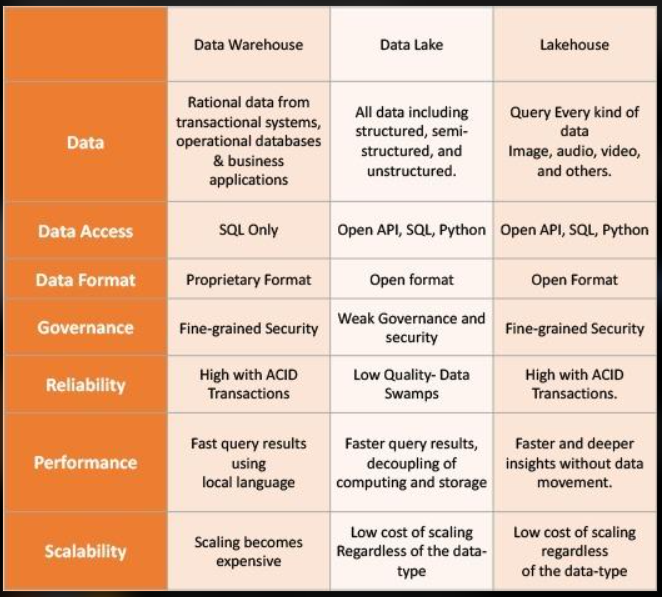
One of the important concepts behind Databricks is the Lakehouse architecture.
To understand it, first let's look at two traditional data storage approaches.
Data Lake
A data lake stores large amounts of raw data in different formats.
It can contain:
Structured data, such as database tables.
Semi-structured data, such as JSON files.
Unstructured data, such as documents, images, and text.
Data lakes provide flexibility for storing large volumes of information.
Data Warehouse
A data warehouse is designed to organize structured data for reporting, business intelligence, and analytical queries.
It helps businesses work with structured information and generate consistent reports.
Lakehouse Architecture
A Lakehouse combines important capabilities associated with data lakes and data warehouses.
It supports flexible data storage along with features for reliable data management, analytics, and governance.
In Databricks, technologies such as Delta Lake and Unity Catalog help support these capabilities.
For example, a retail company can maintain raw customer transactions, organize cleaned sales data, and prepare business-ready datasets for dashboards and machine learning.
The Lakehouse approach helps different teams work with data within a more unified environment.
Learn more from the official Databricks Lakehouse documentation.
3. Understanding Apache Spark in Databricks
Apache Spark is an open-source distributed data processing engine.
It is designed to process large datasets across multiple computing resources.
Imagine a company has millions of sales records.
Processing this information on a single computer may take significant time, depending on the data size and available resources.
Distributed processing allows a workload to be divided across multiple resources so that different parts can be processed in parallel.
Apache Spark supports capabilities such as:
Large-scale data processing.
Data transformation.
Batch processing.
Streaming data processing.
SQL analytics.
Machine learning workflows.
Databricks provides an environment for working with Apache Spark and related data technologies.
It is important to remember that Apache Spark and Databricks are not the same thing. Spark is an open-source processing engine, while Databricks is a broader data and AI platform.
Explore the official Apache Spark website to understand its technology and capabilities.
4. What Is Delta Lake and Why Is It Important?
When organizations process large amounts of data, maintaining data reliability is essential.
This is where Delta Lake plays an important role.
Delta Lake is an open-source storage framework that adds reliability features to data lakes.
Some important capabilities include:
ACID Transactions: Helps maintain reliable and consistent table operations.
Schema Enforcement: Helps ensure incoming data follows the expected structure.
Time Travel: Supports accessing previous versions of Delta tables.
Data Versioning: Maintains a history of table changes.
For example, imagine an organization processes daily sales data.
If an incorrect dataset is introduced, the organization may need to investigate the changes and recover an earlier valid version.
Delta Lake provides features that support these types of data management requirements.
Learn more from the official Delta Lake documentation.
5. What Are the Main Capabilities of Databricks?
Databricks supports multiple workloads within its data and AI platform.
Let's understand some of the major areas.
A. Data Engineering
Data engineering focuses on collecting, processing, transforming, and preparing data for analytics.
Organizations use data engineering workflows to:
Ingest information from different sources.
Clean and transform datasets.
Build automated data pipelines.
Apply data quality checks.
Prepare business-ready data.
For example, a retail company may combine sales records, inventory information, and customer transactions to create a unified dataset.
B. Databricks SQL and Analytics
Databricks SQL allows users to query and analyze data using SQL.
Analysts can use it to:
Calculate business metrics.
Analyze sales performance.
Identify customer trends.
Compare regional performance.
Prepare datasets for dashboards.
Organizations can also connect business intelligence tools such as Power BI and Tableau to supported Databricks SQL environments.
C. Machine Learning
Machine learning helps organizations identify patterns in data and build models that can make predictions.
Examples include:
Customer churn prediction.
Demand forecasting.
Fraud detection.
Recommendation systems.
Predictive maintenance.
Databricks supports machine learning workflows, including model development and experiment tracking through MLflow.
D. Artificial Intelligence and Generative AI
Databricks also supports AI and generative AI applications.
Businesses can explore use cases such as:
Intelligent chatbots.
Document analysis.
Natural language data exploration.
AI-powered business applications.
Automated information processing.
These solutions depend on suitable data, models, evaluation, security, and governance.
E. Data Governance with Unity Catalog
Data governance is essential when multiple teams work with organizational information.
Unity Catalog supports centralized data governance capabilities, including:
Data discovery.
Access control.
Data lineage.
Data permissions.
Governance across data and AI assets.
It helps organizations manage who can access information and understand how data is used and transformed.
6. Understanding the Databricks Medallion Architecture
Another important concept in Databricks is the Medallion Architecture.
It organizes data into three main layers: Bronze, Silver, and Gold.
Bronze Layer – Raw Data
The Bronze layer stores incoming data in its original or minimally processed form.
Examples include raw sales transactions, website activity, and customer records.
Silver Layer – Cleaned and Refined Data
The Silver layer contains data that has been cleaned, validated, standardized, and transformed.
For example, duplicate sales records may be handled, missing values examined, and inconsistent date formats standardized.
Gold Layer – Business-Ready Data
The Gold layer contains refined datasets designed for business reporting, analytics, and decision-making.
For example, an organization may prepare:
Monthly sales summaries.
Product performance datasets.
Customer segmentation tables.
Regional revenue reports.
The three layers help organize the data journey from raw information to business-ready insights.
A simple way to remember it:
Bronze = Raw Data
Silver = Cleaned Data
Gold = Business-Ready Data
RUSA Analytics explores Lakehouse architecture and Medallion-based data organization as part of its Databricks solutions.
You can explore the RUSA Analytics Databricks solutions page for more information.

7. How Databricks Works in a Real Business Example
Let's take an online retail company that wants to understand customer behavior and improve product demand forecasting.
The organization collects data from multiple sources:
Online sales transactions.
Website browsing activity.
Customer information.
Product details.
Inventory records.
How can Databricks help?
Step 1 – Data Ingestion
Relevant information is collected from different business systems and data sources.
Step 2 – Data Processing
Data processing technologies such as Apache Spark help transform and combine large datasets.
Step 3 – Data Organization
The organization can structure its data using Bronze, Silver, and Gold layers.
Step 4 – Reliable Data Management
Delta Lake provides features for managing reliable data tables.
Step 5 – Analytics
The company can analyze product sales, customer behavior, regional trends, and inventory performance.
Step 6 – Machine Learning
Machine learning models can use historical sales and other relevant information to estimate future product demand.
Step 7 – Business Intelligence
Prepared datasets can support Power BI or Tableau dashboards so business teams can understand the results.
This example shows how data engineering, analytics, and machine learning can work together within a modern data platform.
For a more detailed explanation of this workflow, read our existing RUSA Analytics article:
8. How Databricks Connects with SAP and Power BI
Databricks becomes particularly useful when organizations need to combine information from different enterprise systems.
SAP helps organizations manage core business operations such as sales, finance, inventory, purchasing, and production.
Databricks provides capabilities for combining relevant data from SAP and other sources, processing it, and supporting advanced analytics.
Power BI can then help present prepared business information through interactive reports and dashboards.
A simplified conceptual flow looks like this:
SAP + Other Data Sources → Databricks → Analytics and Data Preparation → Power BI Dashboards
For example, a manufacturing company may combine SAP inventory and production information with machine sensor data.
Databricks can help analyze these datasets together, while Power BI can present production performance and inventory insights to management.
However, not every organization needs all three platforms. The architecture depends on data volume, business requirements, analytics needs, and existing systems.
At RUSA Analytics, we explore how SAP, Databricks, and business intelligence platforms fit into modern enterprise data environments.
To understand the SAP foundation, revisit our first article:

9. Why Are Organizations Adopting Databricks?
Organizations are increasingly working with data from multiple applications, databases, cloud environments, and business platforms.
Databricks provides capabilities that can help organizations address several data challenges.
Important benefits include:
Unified Data Environment: Supports data engineering, analytics, and AI workloads within one platform.
Scalable Processing: Supports processing large datasets using distributed computing.
Advanced Analytics: Helps organizations explore business patterns and trends.
Machine Learning and AI: Supports predictive models and AI-powered applications.
Data Governance: Provides tools to manage data access, lineage, and governance.
Business Intelligence: Supports analytical workflows and connections to reporting tools.
The right architecture and platform choices should always depend on an organization's business requirements, data strategy, and technical environment.
10. Learn Databricks with RUSA Analytics
Understanding a new technology becomes easier when concepts are explained through structured learning and business-oriented examples.
At RUSA Analytics, we provide Databricks training and help learners understand the fundamentals of modern data engineering, analytics, and AI.
Our learning approach covers important concepts such as:
Databricks fundamentals and Lakehouse architecture.
Data engineering and data pipeline concepts.
SQL and Python for data processing.
Apache Spark and PySpark.
Delta Lake and data management.
Medallion Architecture.
Machine learning and AI fundamentals.
Enterprise data integration concepts.
We also explore how Databricks fits into broader enterprise data environments involving business systems and analytics platforms.
Explore the RUSA Analytics Databricks solutions page to learn more about our platform capabilities and approach.
11. SAP + Databricks Learning Series: Continue Reading
To understand enterprise systems, data platforms, integration architecture, and business transformation.
Part 1 – Introduction to SAP: Understanding ERP and Enterprise Business Operations
Learn how SAP supports finance, sales, procurement, inventory, and production processes.
Part 2 – Introduction to Databricks: Data Engineering, Analytics and AI
You are reading this article.
Part 3 – Why Connect SAP and Databricks?
Understand the business reasons for connecting enterprise systems with modern data platforms.
Part 4 – SAP and Databricks Integration Architecture
Explore the high-level architecture, data-sharing layer, and possible bidirectional data exchange.
Part 5 – The Future of SAP and Databricks: Enterprise Transformation
Discover industry applications, AI-powered analytics, enterprise transformation, and career opportunities.
Conclusion
Databricks is more than a platform for processing data. It brings together data engineering, analytics, machine learning, and artificial intelligence to support modern enterprise data solutions.
From the Lakehouse architecture and Apache Spark to Delta Lake, Unity Catalog, and the Medallion Architecture, each component contributes to building a reliable and scalable data environment.
When combined with business systems such as SAP and reporting platforms such as Power BI, Databricks can help organizations gain deeper insights from information across multiple sources.
At RUSA Analytics, we believe that understanding how technologies work together is just as important as learning individual tools.
Learn. Explore. Build with RUSA Analytics.


Comments